
BEING THERE
Eric Smith and Chris Leroux called a fine game on Sportsnet Radio Network Saturday earlier this month as the Blue Jays walloped the Twins 11-4 in Minneapolis. It’s especially remarkable if you know they did so from a studio in another country.
“It’s a sunny afternoon in Minneapolis,” Smith said.
He went on to detail the Twins unis, the team’s third alternative home set.
“Minnesota back to the same uniform they wore for game one on Thursday night. Twin Cities across the chest in that white, the sort of slightly cream-colored jerseys trimmed with the navy blue,” Smith said.
As the game began, there came the special sauce, local color.
“The first inning is brought to you by Armstrong Bird Food,” Smith read. “Armstrong Bird Food is the reason birds fly north. Feeding Blue Jays since 1986.”

Local color
Image by Armstrong Bird Food
The broadcaster himself featured a local identifier, revealing the many baseball words and phrases that include “out.” All in the Canadian “oat” pronunciation.
“After a disastrous start, Cease gets the strike-oat,” Smith called. “That’s the first oat of the inning following the leadoff homer.”
“Oat of play right over the dugoat.”
“Wallner grounds oat.”
“Guererro Junior digs that throw oat of the dirt to record the second oat.”
“Kazuma Okamoto goes deep, it’s long, it is OAT of here.”
“It is aboat time the Blue Jays bats showed a little life.”
A proper game call lets me see a baserunner’s stirrups, how many buttons are left undone on an third baseman’s jersey, the set of the cap on a centerfielder. Tell me about the stance of the batter, the details of the hitch in the pitcher’s delivery, where the leftfielder is playing this hitter and the stance of the first baseman and how it changes with two strikes.
The announcer is there in my place, on the scene to describe what it is like at the ballpark.
Only Smith and Leroux were not there. They were not in Minneapolis. Neither was at Target Field. Both were in a studio back in Toronto.
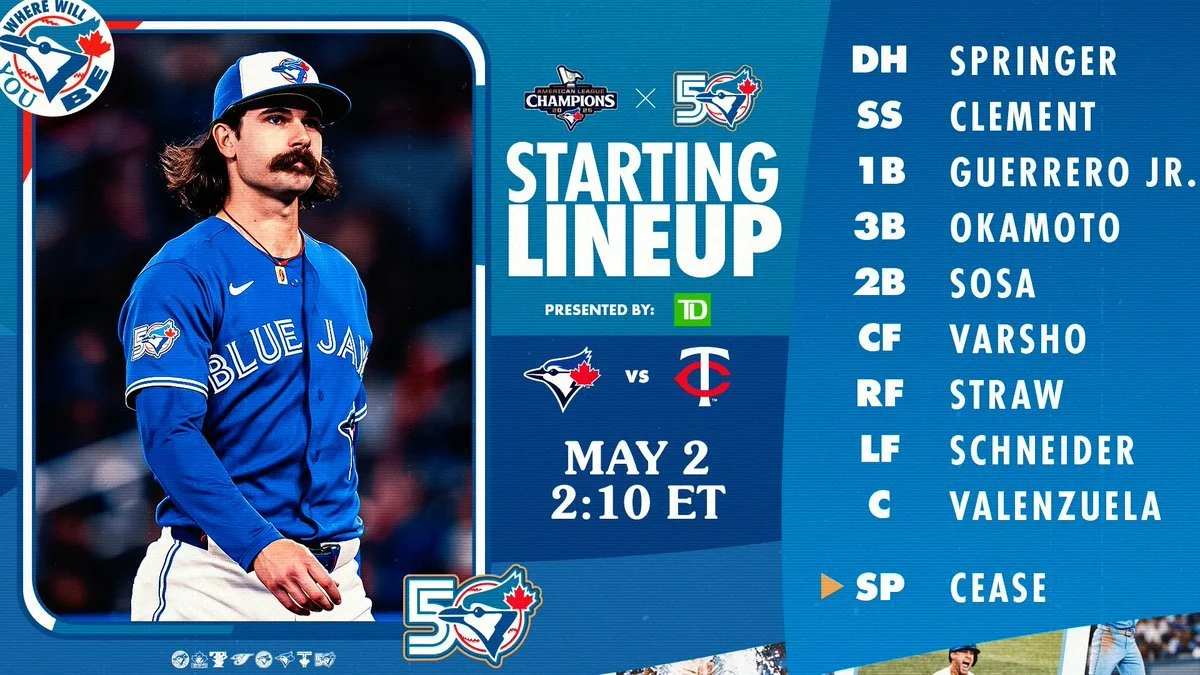
Jays fly high
Image from @BlueJays
Toronto doesn’t send its radio crew to road games. Angels broadcasters, likewise, work only from home.
In 2020, all radio broadcast crews worked remotely for road games. The Blue Jays had a star-crossed 2020 and 2021 when the coronavirus played havoc with Major League Baseball as well as restricted international travel. Toronto has not put radio announcers on site at road games since. For Toronto and the Angels, they don’t see the need to have broadcasters with the team when it’s traveling.
“I’m not sure what’s happening,” Leroux said during Saturday’s show, as umpires huddled in the fifth.
The Twins challenged a safe call at first and it was overturned. Jesus Sanchez was ruled out at first to complete the double play. Leroux may have very well said the same thing if they were in a booth at Target Field.
But he wasn’t there.
‘Showing up is 80 percent of life,’ as the kids don’t say. Back when I called myself a reporter I know how tempting it was – and covering state government in Florida there is plenty of opportunity – to cover hearings and speeches and meetings remotely. I can say definitively that just because it is possible does not make it better. Key understanding is lost when reporting is done from a video feed. A reporter or radio play-by-play announcer is at the mercy of where the TV broadcast points its cameras. If you are not there, you are subject to the whims of technical failures. What if the feed goes out? You miss nuance and detail and context. And you can’t chat anybody up if you’re in a dark room in another country.
The Toronto radio team watched on television from 700 miles away.
To their credit, Smith and Leroux were accurate and engaging. Leroux offered perspective, as a former player, a former pitcher. And there is a history of games being called remotely, famously by Ronald Reagan who re-created Cubs games on WHO in Des Moines from a telegraph feed. He was renowned for his ability to fill in the gaps between the barest facts passed along in the dit-dot ticker, providing fanciful flair unmoored from any facts.
As late as the ‘40s, big league teams did not broadcast road games.
So, it’s a reasonable cost-control strategy, it has a long tradition, and the product remains serviceable. A broadcast done from afar, though, is definitionally inferior.
There will be less insight, less discovery, less ability to put me, the listener, in the game. The Jays broadcasters could tell me the temperature – the box score tells me it was 60 degrees and partly cloudy – but not the subtleties of how the wind shifted between innings. Those broadcasters did not stand around the cage during batting practice, they did not have a chance to chat with players, see who was getting treatment from trainers, look at defensive placement or on-deck swings different from what the TV camera chooses to present.
There is no substitute for being present, on the scene. I listen specifically because I cannot be there; that’s what I need from the announcer. I can watch TV myself.