THIS SPACE FOR RENT
Baseball on the radio has a traveling companion: Advertising. It’s not just on the broadcasts. It is everywhere and becoming more so. It is boring.
I have no problem with making money or being assaulted by sales pitches at every turn. I do bemoan the disappearance of idiosyncrasy, of local color, of a unique expression of a place.
Last year, MLB put a German workwear company – that's how it describes itself, a “German workwear company” – on batting helmets in the postseason: Strauss. This continues the generalized trend, much of it driven by technology. On a streamed broadcast from Peoria, Arizona, involving teams from Chicago and San Francisco, I was fed an ad for a car dealer in Tallahassee.
“Progress was all right, only it went on too long,” James Thurber said.
When I listened to the Cardinals in the early ‘90s on KWPM in West PLains, Jack Buck and Mike Shannon were near the peak of their powers. Anheuser-Busch* still owned the team. If you listened to a lot of games, the commercial breaks could sure get repetitive. Busch beer’s “Head For the Mountains” campaign was in full swing and it helped that they had a wide roster of performers record the song. Nick Lowe, Paul Carrack, Leon Redbone, and The Ozark Mountain Daredevils had versions, among others. It offered variety.
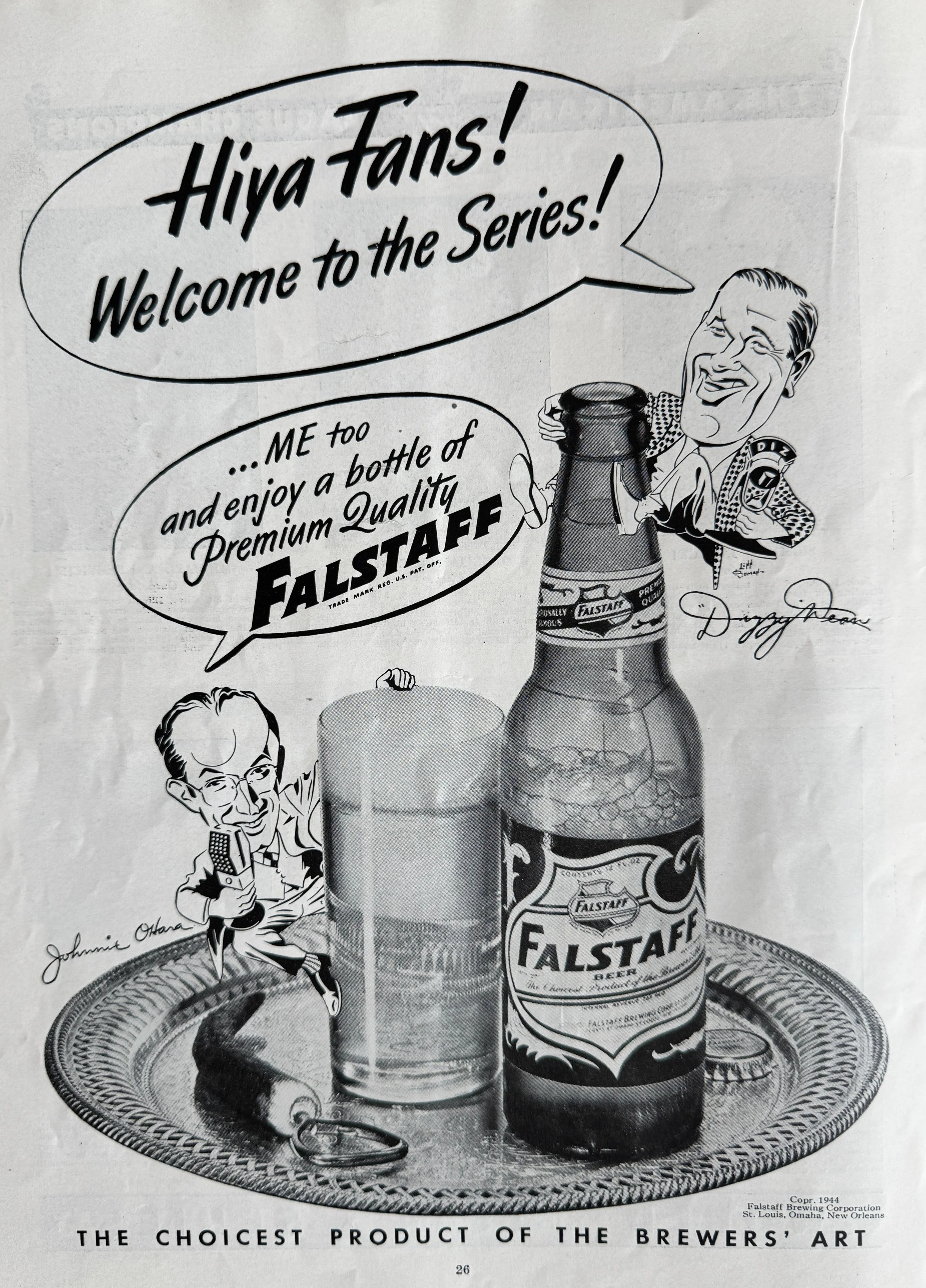
Falstaff
“The Choicest Product of the Brewers’ Art”
— From the 1944 World Series program
Streaming broadcasts have changed, too, and not for the better. The march of progress here is sinking to uniformity and losing local color. Every broadcast’s “sponsors” might as well be a Hardee’s on an I-40 offramp next to a strip mall of vape shops and Mail Boxes Etc. storefronts. (Mail Boxes Etc. is still, it appears, a thing, though the familiar old logo is associated with an Italian firm, “A Fortidia Company,” with a surfeit of generative AI images on its website.) It used to be the radio broadcasts streaming from MLB Advanced Media included local advertisements between innings. The Cardinals broadcast had ads for Schnucks grocery store and Ted Drewes frozen custard and Whitey Herzog’s voice on a commercial for a St. Louis local trade union.
Now, the streaming pre-empts local ads and serves up messages keyed to my geolocation. I get Farah & Farah spots for a Jacksonville personal injury law firm. I get Publix ads.
The advertising is national, pitched to the lowest denominator, and repeated repeated repeated. A mainstay this spring is Kalshi, a prediction market or, more accurately, the most efficient means of separating fools from money. “Turn your opinions into cash.” It’s the perfect tagline for our times and it serves best to predict not markets, but the end of democracy. There is an omnipresent spot for Chumba Casino, an online bright-lights-and-clanging-bell app designed to spike serotonin levels and poke the pleasure centers of the statistically stupid and low-attention span listeners’ frontal cortexes.
I yearn for the low-budget ads for the Party Pantry on CC Highway in West Plains. I could get a six-pack of Busch there, at least.
MLB has not yet figured out how to eliminate the in-broadcast ads, the plugs from the Giants announcers for the Hawaiian Airlines Booth, or the Red Sox Shaws and Star Market, or the law firm who sponsors the reading of the MLB copyright disclaimer on the Cardinals feed.
Ads pervade beyond the radio broadcasts.
There are advertisements on jerseys now – the Cardinals feature Stifel. Twenty-eight other teams have their own deals; only the Tampa Rays** do not have a jersey patch advertiser. Public information on revenue from these deals reveals the $17 million a year MassMutual pays the Red Sox and the $10 million annually paid by Motorola to be seen on the ugliest uniforms in all of baseball worn by the San Diego Padres.
Instead of a staid, albeit locally headquartered, financial services firm, wouldn’t it be great if the Cardinals had Mama Campisi’s Restaurant patches on its unis to promote the great place on The Hill? I would much rather have a sense of the city than a pitch for Roth IRAs.
When I was a newspaper reporter, I bristled at the truth that a majority of single-copy buyers – back when there were actual physical copies and, for that matter, when there were people who would buy them – did so for the advertisements. I came to understand it didn’t matter why they were buying the paper, only that they were. If I was not doing my job well enough, they would not read my stories. I only had to be more useful or interesting than the grocery ads if I did not like them being a motivation to buy.
I do not begrudge advertisers, it’s only the messenger’s technology I want to kill. Even advertising, through remarkable microtargeting (there’s a reason I get lawyers and Publix beyond the ZIP Code of my URL) puts us in bubbles, in resounding chambers of familiarity and like-mindedness.
As with each game my hope is to hear a compelling, delightful story in the same way I want the advertisements to surprise me and reveal something about the people listening with me.
*The Cardinals still play in Busch Stadium. The reason it’s called that fits today’s topic. The brewery bought the team in 1953. The commissioner declared a ban on naming stadiums after alcoholic beverages. So, August Busch Jr. Rechristened what had been Sportsman’s Park as Busch Stadium, ostensibly after himself. Then A-B introduced a new brew and Busch beer was born. The name has endured through three stadiums.
**The Rays now do have a jersey sponsor. Webull, an online investor platform, are now on the Rays sleeve. The patches have an odd feature. In 2024 Hurricane Milton tore off the fabric roof at The Trop, the Rays dome home in south Pinellas County. The stadium could not be used in 2025 and the team played in the Yankees spring training park in Tampa. The Webull patches include a small swatch of the tattered roof fabric.