CAP TAP FTW
Baseball’s first week showcased the revolution introduced to the game this year, the Automatic Ball-Strike challenge system.
Imagine: Seventh game of the World Series. Bottom of the ninth. Full count. Runners on. Home team down two. Here’s the pitch. Called third strike. Game over. Visiting team pours onto the field in celebration.
But wait! The hitter tapped his cap! Up on the scoreboard comes the ABS graphic, powered by T-Mobile. And here comes the verdict...
It was a ball! One-tenth of an inch outside. The ump’s call is reversed and the batter is awarded first base on the walk.
The home team’s cleanup hitter steps in and clouts a three-run home run, a walk-off Series winner.
We are still in the first week of play and we already have multiple examples of how this new twist changes play and changes fan experience and how remarkably possible the scenario above is.
On Opening Day, Boston had a one-run lead over the Reds. Roman Anthony challenged a strike call that would have ended the Red Sox half of the inning. Instead, he won the challenge and earned a walk and extended the inning. Two teammates subsequently came to the plate and hit RBI singles. The Red Sox went to the Reds half of the ninth ahead 3-0 and that’s how it ended.
The series in Cincinnati produced another ABS highlight reel. The Reds Eugenio Suárez challenged two consecutive strike calls by home plate umpire CB Bucknor to keep his at-bat alive. Suárez grounded into an out, but the back-to-back successful challenges were a stark exhibition of the fallibility of umpires.
Bucknor’s calls were challenged eight times that game and six of his calls were overturned. It might have been more, but the Red Sox burned their two failures and were out of challenges early on.
The ABS meme coming out of Seattle was not as consequential, but it was cinematic. Randy Arozarena was up in the second with a full count. Home plate ump Ryan Additon punched him out. Arozarena emphatically thought differently as he tapped his head and proceeded down the first base line, pulling off his batting armor to await the verdict he seemed imminently assured of winning while standing on first base. He did win the challenge, by a 2-tenths of an inch margin.
And then on Sunday, the loudest challenge. The game was slipping through Baltimore’s fingers in the late innings at Camden Yards. The Twins inched back into the game 6-8 in the eighth. In the ninth inning Ryan Helsley came in to pitch and gave up a lined single. Josh Bell worked a walk and the go-ahead run was coming to the plate when Helsley cap-tapped.
The reliever prevailed and Bell took a strikeout-earned seat.
His manager, Derek Shelton, put on a weak Earl Weaver impression and got himself ejected.
Those examples reveal what happened on the field. But what happened in the stands was the amazing thing. ABS has brought baseball into the 21st century. Heck, it’s dragged baseball out of the 19th century introducing flashing lights, advanced technology, and instant-gratification – you know, the triumvirate of our low-attention-span era – to the bygone nature of the once and future national pastime. The crowds buzzed in anticipation as scoreboards in stadiums around the country switched to huge displays of the strike zone and digital balls loomed ever larger on the screens. The big ABS reveal induced roars.
The most highly esteemed Joe Posnanski says the introduction of the challenge systems means it is only a matter of time – and a short time at that – until the computer system is making all the balls and strikes calls.
“I’m more convinced than ever that now, with the genie out of the bottle, the clock for a full-fledged ABS system — with every ball and strike called automatically — is close,” Posnanski wrote.
I do not agree. The challenge and its immediacy – that's a key difference with the video review field-call challenges – bring a certain Roman coliseum vibe to the proceedings, especially to those challenges made in definitive situations; a strikeout could be overturned, a walk could be disallowed.
It is great drama. It offers a complete and separate game to watch.
I see how the umpires have reacted. Some take it as a personal affront, diminishing their authority. This will soon end and the focus will shift away from them. Fans will recognize umpires are human beings failing by tiny fractions of inches to discern a ball’s placement while it is moving at more than 90 mph.
Players who are now giddy with their new power better beware. The critical eye will soon turn to you. You and your team’s strategic approach and success rates will be under uncomfortable scrutiny. How could you be so dumb to squander and fail with challenges during low-leverage, early inning pitches? Did you not foresee you would need that challenge here in the ninth when an egregiously missed call results in a strikeout and the end of the game with the winning run in scoring position?
Think about how much football fans love to disparage coach’s clock management, a seemingly easy and small thing with huge consequences. ABS will provide ten times as much fodder for fan disgruntlement.
This is also yet another skill to savor or decry with every player. Yadi Molina was an incredibly valuable player for the Cardinals in the way he called a game, defended his position, and framed pitches. Think what an assassin he would be with ABS challenges.
Then think of how much vitriol will rain down on the head of players with poor judgment, those who consistently make bad choices about challenging calls. And it’s easily quantified. MLB has got you covered. Who is surprised Mike Trout and Salvador Perez have the early top spots?
For all the robotic excitement of the weekend, it’s worth remembering the action on the field was better. Brett Holland and Josh Lewin on WBAL had a great call on Sunday as the O’s beat the Twins*.
In the sixth, Lewin recounted a fast-paced inning with enthusiasm for the play on the field and the possible future of the team.
“That’s a line drive base hit into right field. O’Neill will score, Mayo behind him. And the Orioles have seized the lead on a Beavers double,” Lewin said. “A two-out rally and the kids are doing it.”
That’s a call no one can challenge.
*Uni watch. Minnesota’s road caps, something they have somehow been wearing since 2023 without me being aware of it, are monumentally bad. It’s a block M with a red star nestled in the divot of the sans serif letter. It is meant to represent, unsurprisingly, the north star.
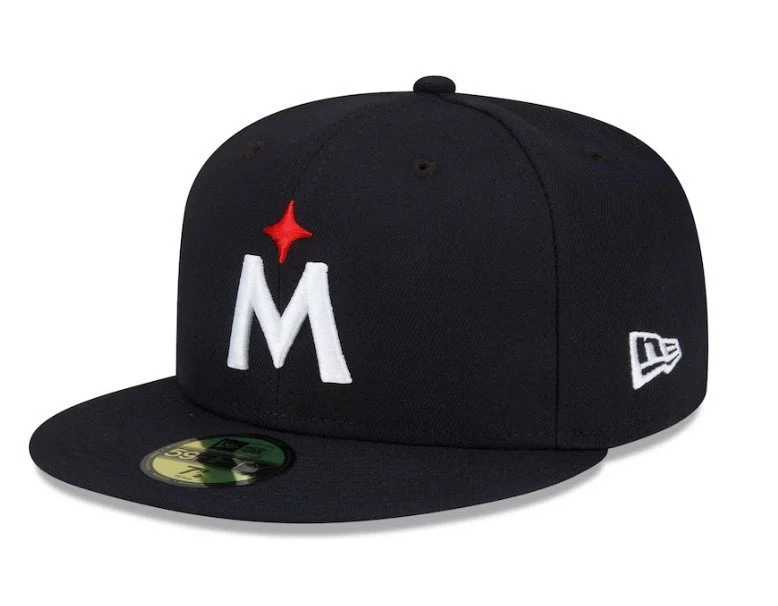
Twins road caps
That red thing? The North Star.