ABS of STEAL
Ricky Henderson would get screwed by our robot overlords.
The topic of the spring on baseball broadcasts – the new Automatic Ball-Strike system that allows hitters, catchers, and pitchers to immediately challenge a home-plate umpire’s calls – is getting loads of attention and details are coming into focus.
UPDATE: It’s true “the robots have arrived” and now, right on time, you can prove it with data. Check out the leaderboard you can create of the best performers with ABS on the MLB website, Savant. There’s a graphic visualization. There are aggregate stats. After the first week of spring training, 53 percent of challenges were successful. Shouldn’t it be higher?
The game situations where the challenges have been deployed also gets more interesting, if chaotically, as teams have clearly begun the pre-World Baseball Classic portion of 2026 spring training with no rules, no strategy, and free rein for batters and catchers to question calls at any point. Broadcasters speculate the last weeks of spring training, as rosters diminish to final cuts and the regular season looms will see much more defined strategies emerge.
The import of a strategic reserve of challenges came Monday in the A’s game against the Giants at Scottsdale Stadium in the Cactus League.* Joe Ritzo is the lead play-by-play guy for the Single A San Jose Giants.
Ritzo has been on the radio for the San Jose club for 15 years. He also handles spring training. In this way Dave Flemming can be in Waco tonight calling a Big 12 basketball game for ESPN instead of in Arizona. Ritzo had his Big League debut in August 2019 under similar circumstances when, similarly, “Dave Flemming would be unavailable due to a national outlet commitment.” Ritzo strikes just the right tone for a spring game, a light touch but a firm command of the form. You can read about his time stepping up to the Bigs with Jon Miller in this story from back then. I look forward to tuning in to his work with San Jose once the season starts.
Monday’s game’s end was influenced by an ABS challenge. It didn’t ultimately make a difference, but it highlighted the tantalizing possibility.
Ryan Lasko, the A’s righthanded centerfielder, took a pitch on a 2-2 count with two outs in the ninth. Home plate umpire Brock Ballou called it a game-ending strike. Lasko, with the A’s holding an unused challenge, immediately signaled he wanted to beseech a higher power. Ballou’s judgment was overturned on electronic appeal. The count went to 3-2 and Lasko lived another day. Or at least another pitch. He grounded out on the next delivery and the game was over.
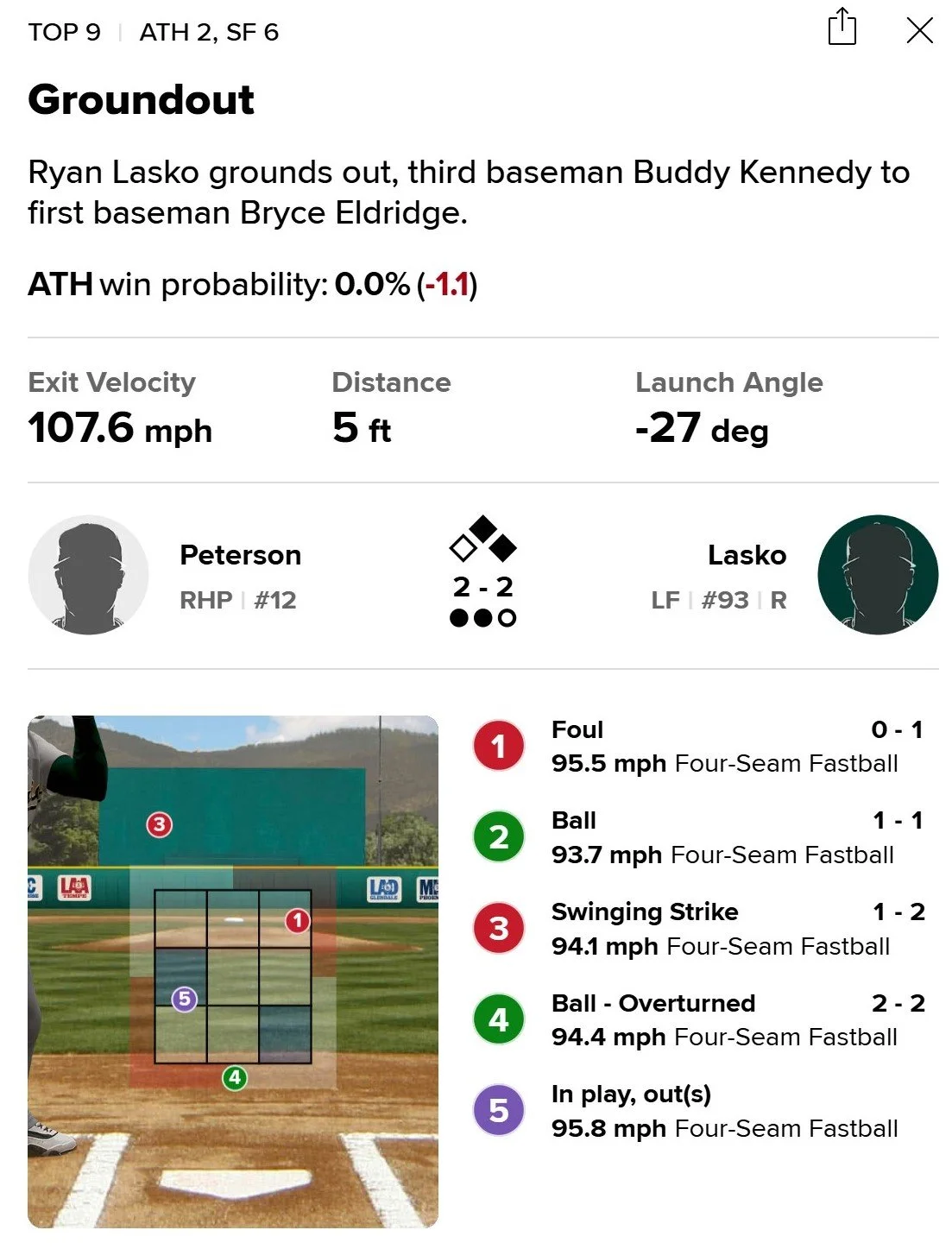
Anatomy of a corrected call
Pitch 4, shown by ABS to have just missed the bottom of the strike zone, was overturned and extended the game one more delivery.
But what if he’d gotten on? What if that was the first of a series of hits and extra-base knocks and homers and the A’s won? Alas, it didn’t turn out that way, but at least Lasko couldn’t use the blown call as an excuse.
Articles popped up over the weekend, including this overview from the Brewers beat writer for MLB.com of how the system is being implemented. Others addressed team approach and practical application.
Jayson Stark in The Athletic provides a primer with predictions about strategy and logistics.
He illustrates the import of the new system’s promise for the future by referring to the past in last year’s National League Division Series and a hinge moment in Game 4 – a called ball on the fifth pitch of an at-bat in the seventh inning. It could have been a punch out on strikes. Instead, Alex Call worked a walk, came around to score the tying run and the Dodgers won in extra innings to advance to the World Series instead of the Phillies.
Coulda. Woulda. Shoulda.
More interesting is Stark’s prediction there will still be plenty of umpire influence, making subjective calls about the rules of the appeals system.
Home plate umps can disallow a challenge if it doesn’t come fast enough – within 2 seconds, by rule – or if, in the ump’s judgment, the impetus to challenge comes from the dugout or anywhere other than straight from the catcher, pitcher or batter, the only individuals empowered to initiate the digital review and without outside help.
The electronic system is two-dimensional after testing with a 3D zone proved technically problematic. This seems, by a strict textualist reading of the rules, at best a compromise and at worst a warping of the game. A strike is supposed to include passing through any part of the zone, even though a pitch could conceivably cause the ball to pass by parts of the strike zone while sneaking through another part of it.
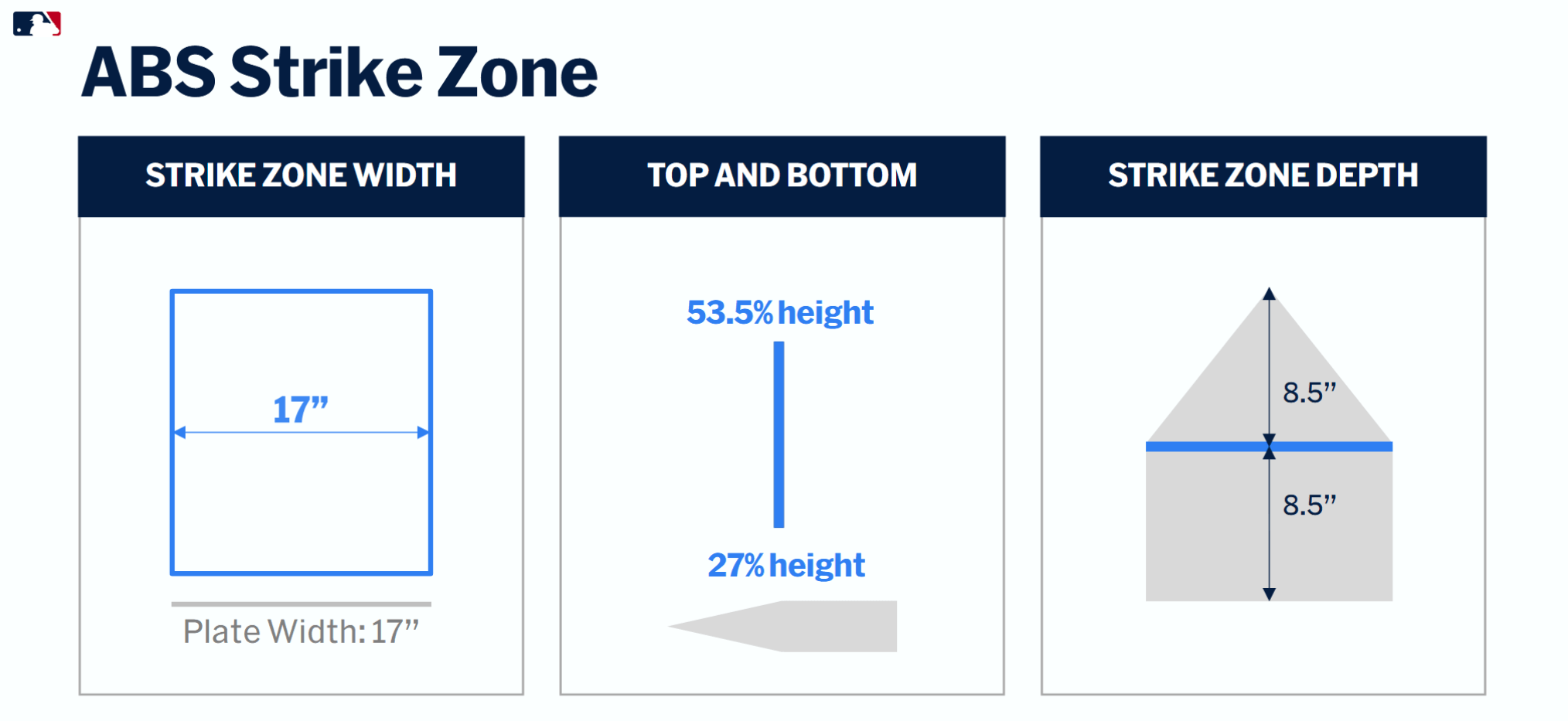
And then there’s how the strike zone gets set, personalized for each player.
“MLB studied the problem for multiple years ... before settling on the top end of the zone at 53.5 percent of a hitter’s height, and the bottom at 27 percent of the player’s height,” the MLB.com story says.
Rickey Henderson is among the most interesting men to ever play baseball, not least because of his distinctive crouch and Rickey’s endearing habit of referring to Rickey in the third person.
Eighty-one times in his distinguished career, Henderson started off a game by hitting a home run. More than anyone else did it. Four times he led the league in both walks and stolen bases, achievements that are correlated but still beyond belief. He had most stolen bags in a season a dozen times and, of course, is the career stolen-base king with 1,406 as well as being the career leader in runs – you know, the whole point of offensive baseball and he has the most of anyone at 2,295. Two thousand two hundred and ninety-five.
He had an exaggerated crouch when at the plate, coiled around his own bat, it appeared. He was a loaded spring, it seemed, set to unleash. A cobra ready to strike. Columnist Jim Murray said Rickey Henderson had a strike zone “smaller than Hitler’s heart.”
But the ABS would make his strike zone larger, based on him standing, barefoot, against a wall with his back touching instead of based on his crouch.
“Rickey don't got time for that!” as Rickey himself said once.
Accuracy, or the techno faith in it, comes at a price.
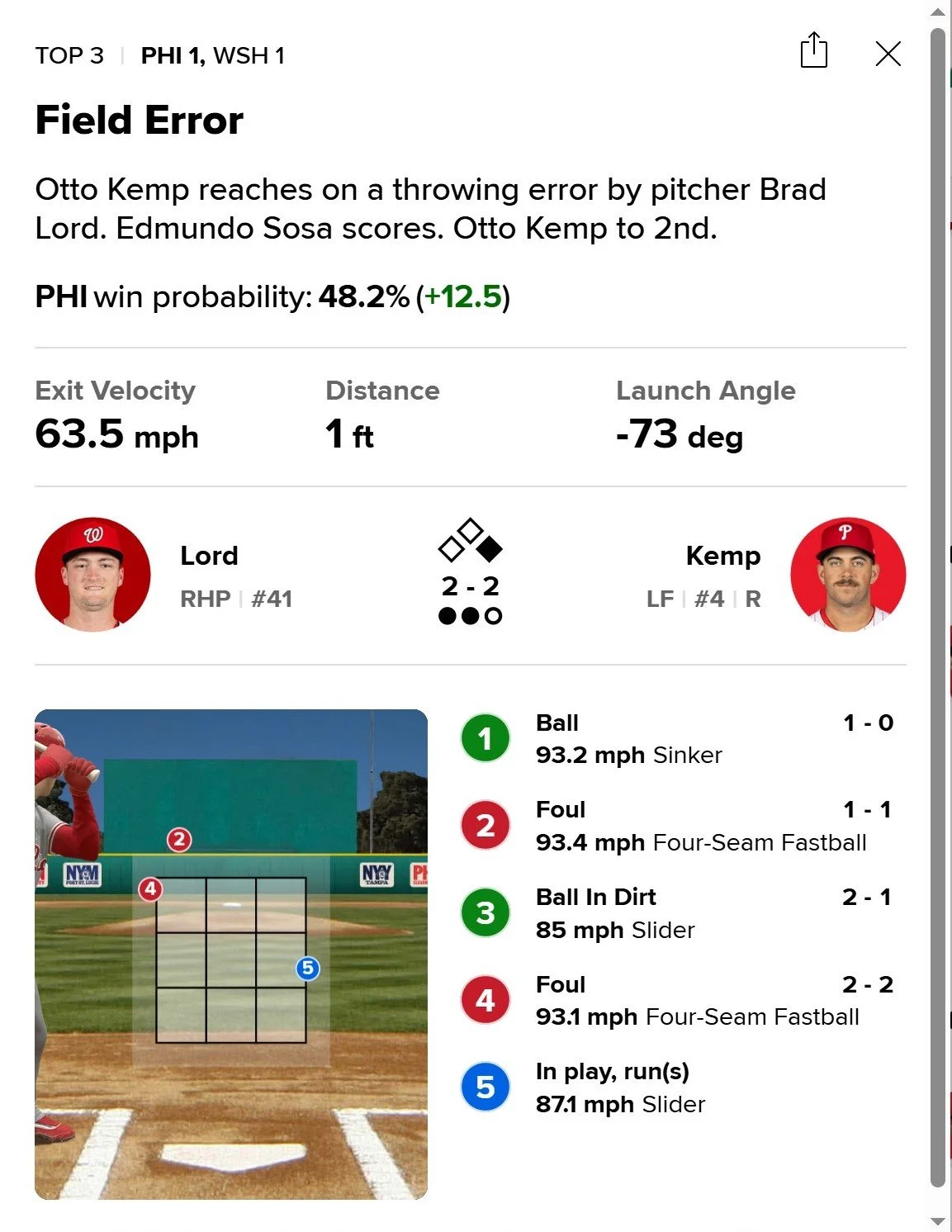
*I listened to another game Monday. Confusingly, the Nationals train at CACTI Park of the Palm Beaches. That’s in the ... Grapefruit League. The Nationals game against the Phillies was called by Charlie Slowes and Dave Jageler, a convivial pairing for the Nationals who have had to describe the performance of very poor teams in recent years: In the full seasons since their championship campaign in 2019 the Nats have lost 97, 107, 91, 91, and 96 games. This spring training game continued the trend of bad play. The game ended in a 5-5 tie – an anomaly perhaps explained by a cross-state bus ride back to Clearwater on the Gulf Coast for the Philadelphia team. All of the Phillies scoring was unearned. While that’s a subjective moral judgment, the first was true and directly attributable to a pitcher error. An unearned run was allowed by Tallahassee’s own Brad Lord. The run scored when the right-handed pitcher botched his throw to first with two outs and Otto Kemp was safe because of it and further advanced to second. Do you know anyone named Otto? I do not, now or ever in my life. What should have gotten Lord out of the inning instead scored Edmundo Sosa. Slowes and Jageler called the game on streaming only, not over the air on flagship station WJFK 106.7. This is a thing in spring training. The Nats broadcast is distinguished by distinctive audio. An on-field mic, in collaboration with a producer or engineer who slides the gain way up as the pitch comes home, gives a unique sound FX. The effect conveys a distinct whoosh and pop as each delivery crosses the plate and smacks into the catcher’s glove – or, alternatively, a whoosh and a crack of the bat when contact is made. It makes for a lively listen and delineates each pitch for the listener.