
CLOSER TO HEAVEN
Every day could be Jackie Robinson Day. Should be.
At least Robinson’s legacy should not be left to a single day.
On a warm June Saturday in 2019. I was riding my bicycle along the backroads of Florida and Georgia’s Red Hills. Red clay and pine trees, cotton crops and quail-hunting parties. I was pedaling in Georgia, but just. I turned from Meridian Road onto Hadley Ferry Road, a new route for me. Over a brief rise and a gentle turn to the left I came upon a small roughly mown patch of grass and roses. There was a historic marker. I pulled over.
It is so unlikely. The sign marks the birthplace of Jackie Robinson on a site where the house burned down in 1996. Only the chimney remains. The brick chimney was encircled by chain-link fence, wrapped tight as if to protect it from harm. The cast-metal sign marker was pockmarked by a shotgun blast.
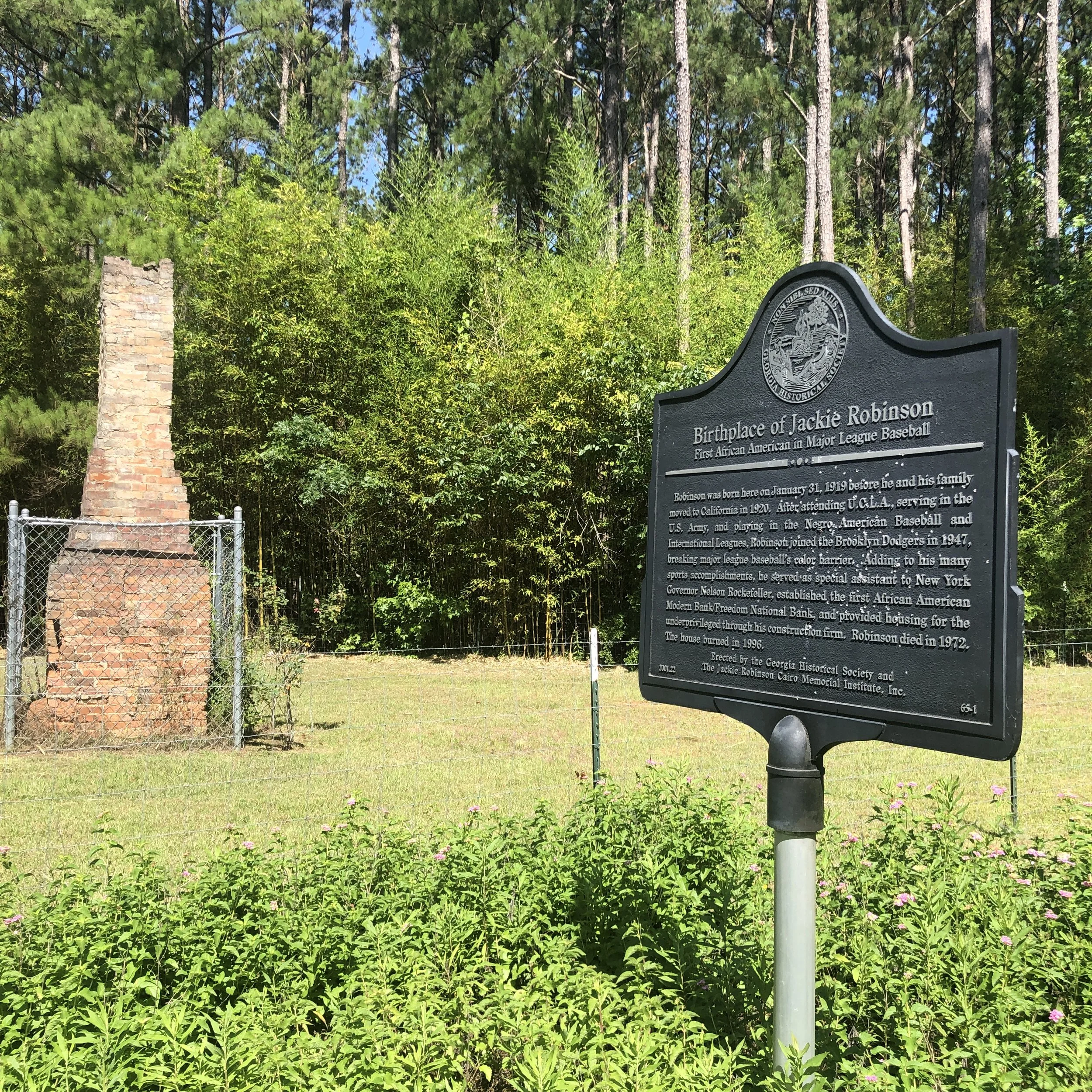
“After attending U.C.L.A., serving in the U.S. Army, and playing in the Negro American Baseball and International Leagues, Robinson played for the Brooklyn Dodgers in 1947, breaking Major League Baseball’s color barrier.”
It is not accurate to say the historic spot is in the middle of nowhere. You’d have to go 5 miles closer to civilization from this spot in Grady County to reach the middle of nowhere. Jackie was born here on January 31, 1919, to Terry and Mallie Robinson on a plantation owned by James Madison Sasser. Terry worked as a wage-earning laborer until Mallie worked out a suitable sharecropping deal.
Arnold Rampersad wrote the comprehensive Jackie Robinson: A Biography, published in 1997. He describes the circumstances of Robinson’s parents’ lives and his four older siblings. Terry and Mallie had a roller coaster relationship of estrangement and reconciliation that ended at last when Terry left for good toward the end of July the year Jack was born. Mallie’s parents, Washington McGriff and Edna Sims McGriff lived nearby on 12 acres Edna owned. The McGriff, Sims, and Hadley families were prominent black landowners determined to earn prosperity for themselves. Mallie’s choice of husband did not meet with her parents’ approval. Terry Robinson came up from Florida and lacked the same commitment to hard work and improvement, education and attainment, that Washington and Edna held.
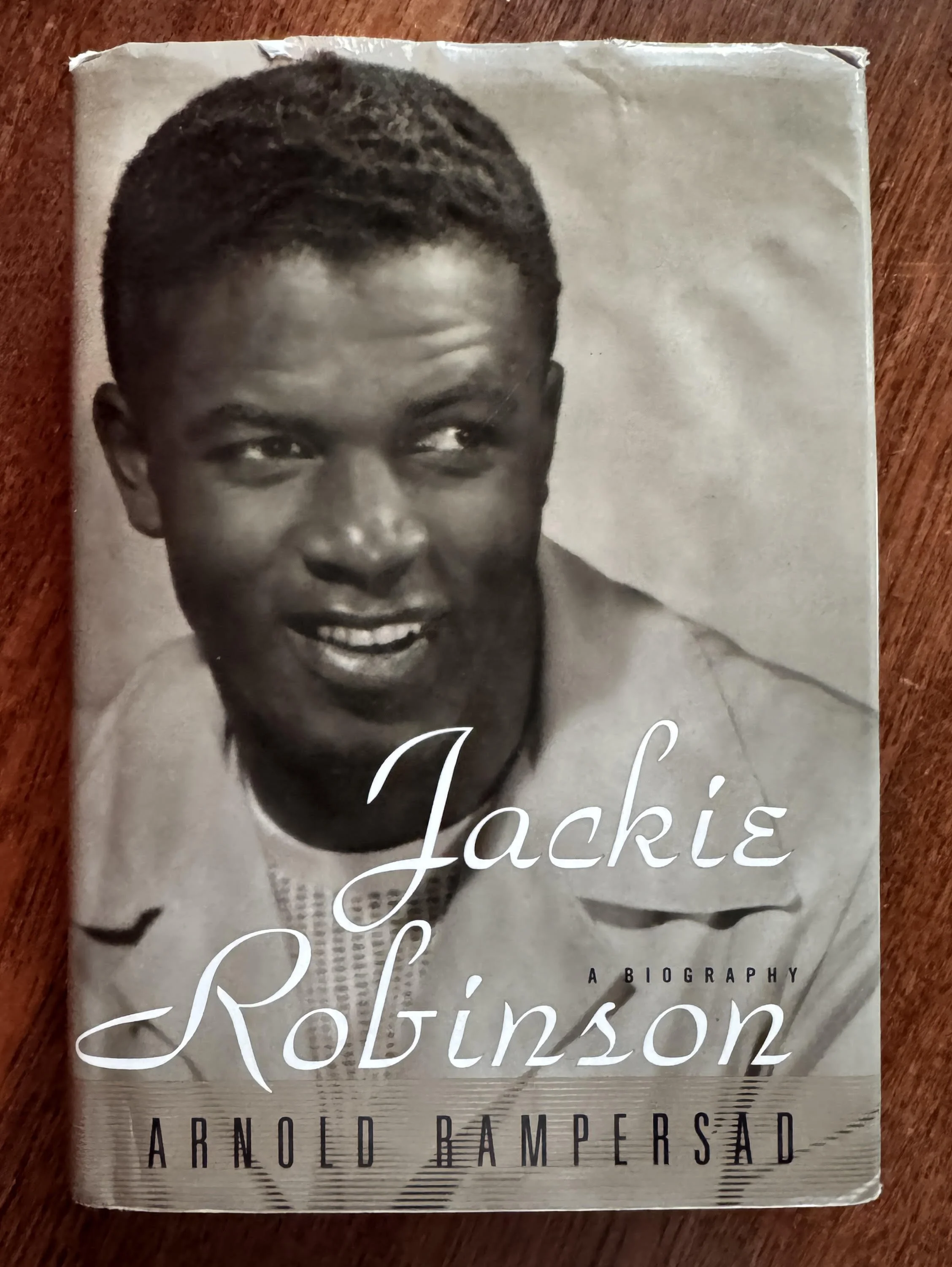
Arnold Rampersad
When Mallie’s brother Burton Thomas came home for Thanksgiving in 1919 he sang the praises of Los Angeles, a tune that got Jackie’s mother humming along to the melody and, eventually, singing from the same page.
“If you want to get closer to heaven, visit California,” Burton told his family, Rampersad writes.
Life around Rocky Hill, the part of Grady County where Jack was born, was difficult for black people. The distinguishing characteristics of neighboring Thomas County, where I live now, are described recognizably by Rampersad and based on historic documents and primary research.
“In the 1880s, local blacks also benefited when tourism became important, as well as a new plantation culture that brought rich Northerners, including those with names such as Whitney, Vanderbilt, and Rockefeller, to acquire estates in the region. Attracted by the sunny climate, stunning landscapes, and rock-bottom prices after a plague of bankruptcies, the newcomers began to transform the decrepit estates according to their fanciful notions about the Old South in its golden age, before the Civil War. Blacks were essential to this fantasy, which also encouraged not only prosperity but new standards of civility as well. ... In 1910, when the local Board of Trade published a brochure designed to attract new businesses to Grady County, it offered as one inducement ‘the interesting fact’ gleaned from the last U.S. Census that ‘the rural South is becoming white with the coming in of farmers from the Central West’ to buy cheap land in Georgia. Cairo, the brochure boasted, ‘is the Diamond Stud on Grady County’s Snow-White Front.’”
Mallie’s brother’s sunny descriptions of Southern California were as attractive as the hardscrabble struggles of a single black mother in a racist society were intolerable.
In May 1920 she, her sister, the sister’s husband and their two children banded together with Mallie and her five children to set off by train from the Cairo station, aimed at Los Angeles, where they arrived and Jack grew up to be a four-sport star for UCLA.
He did not grow up in South Georgia, but he would have known the perils of its society from his mother who fled to give herself and her children a chance to thrive. It is difficult to imagine the change in Mallie’s circumstance, outlook, and opportunity from a cottage in Grady County, population 1,044 when she left, to Los Angeles and its 577,000 people in 1920. Surely Los Angeles was no utopia free of racism, but it was also not Jim Crow Dixie. Could Jack Robinson have thrived as he did? He certainly would not have played baseball, basketball, football, and run track at UGA as he did at UCLA. It was not until 1972 that Georgia fielded its first integrated varsity team. In California, Robinson ran for more than 12 yards per carry during the 1939 season at UCLA. He won the 1940 national NCAA title in the long jump while running track for the Bruins.
It is dangerous to ascribe motives to whoever defaced Robinson’s birthplace historical marker with buckshot. Plenty of road signs on these South Georgia back roads are marred by late-night target practice from a speeding F-150 and those have nothing to do with racism. At the same time, there is no desecration of Ty Cobb’s historical marker in Royston in far north Georgia.

Jackie Robinson Birthplace panorama
In 2021, Major League Baseball, along with the original sponsors of the historical marker, erected a new, unblemished sign, joining the Georgia Historical Society and The Jackie Robinson Cairo Memorial Institute, Inc., as named benefactors of the memorial. It is an unequivocal, if minimal, good thing to have done for MLB. Might they not come up with a more aesthetically pleasing way to safeguard the chimney from vandals, perhaps improve the landscaping, maybe include some contextual material about Jackie’s family, particularly those land-owning relatives.
But that is looking outside to understand what is only properly understood from within. We are all responsible for ourselves first before we do what we can to make all of us better.
In a season of transition – for me, for people close to me, for things bigger and smaller than all of us – it is worth remembering it is not where you start out but where you are going. Let us go forward, let us be resolute, let us be unsure of the way, but certain of our destination. Baseball and its narrative, the story of the game, the story of this country, and the story of a single game, a full season, move toward an ideal, an eternal reach for perfection – a swing, a pitch, a route to the ball, a perfect team. A more perfect union.
There is a story of a man who starts in a house attached to this chimney on Hadley Ferry Road. The way the narrative unfolds from this beginning is full of choices and forces. Its ending is not certain along the way, even now. We do know where Robinson took the story, his story, his accomplishments, and his strength. All of us continue to tell it, to call the game as we see it, some of us moving ever closer to heaven. Meet those people at the station and get on the train.