
‘THEY’RE GOING TO TRY TO SCORE HIM’
Aural reminders bring a whole year flooding back, all the senses awash in time-worn treasures.
The radio versions of 1964 Cardinals season and the 1967 World Series-winning campaign are more vivid to me than the 1982 version – when St. Louis won its ninth championship. I remember this team with delight. I remember Whitey Ball. I remember Willie McGee and how we called him Willie ET because, well, he looked like ET and the movie came out that summer.
Willie also hit triples like an extraterrestrial. He and Lonnie Smith both hit 8 triples that year. (Another Willie – the Royals Willie Wilson – hit an incredible 15 three-baggers that season.) Willie McGee was a rookie and a wonder all summer long.
I was alive and aware in 1982, so you might think that WOULD be an advantage over 1964 when I did not exist and 1967 when I was a crying excretion machine. I’ve had a lifetime listening to LP records for those seasons.
I remember baseball from those ‘60s campaigns because the records are the only thing I have to form a memory. I’ve got loads of memories besides baseball from the summer I was 17. The Cardinals are just among them. I have had those two albums from the ‘60s championship teams my whole life. This album commemorating the 1982 season has only been in my possession, I have only been aware of its existence, the last three weeks.
Memories overwhelm my imagination from 1982. I remember days in Steve’s Citation, driving to the Finley River. I remember nights in Bob’s Volare cruising the Brown Derby parking lot. I remember riding my bicycle out Greene County NN and US 125 to Ozark and Sparta and Chadwick. I drove my mother’s ‘67 Volkswagen sedan and listened to AM radio. Elvis Costello’s Imperial Bedroom was released on July 2.
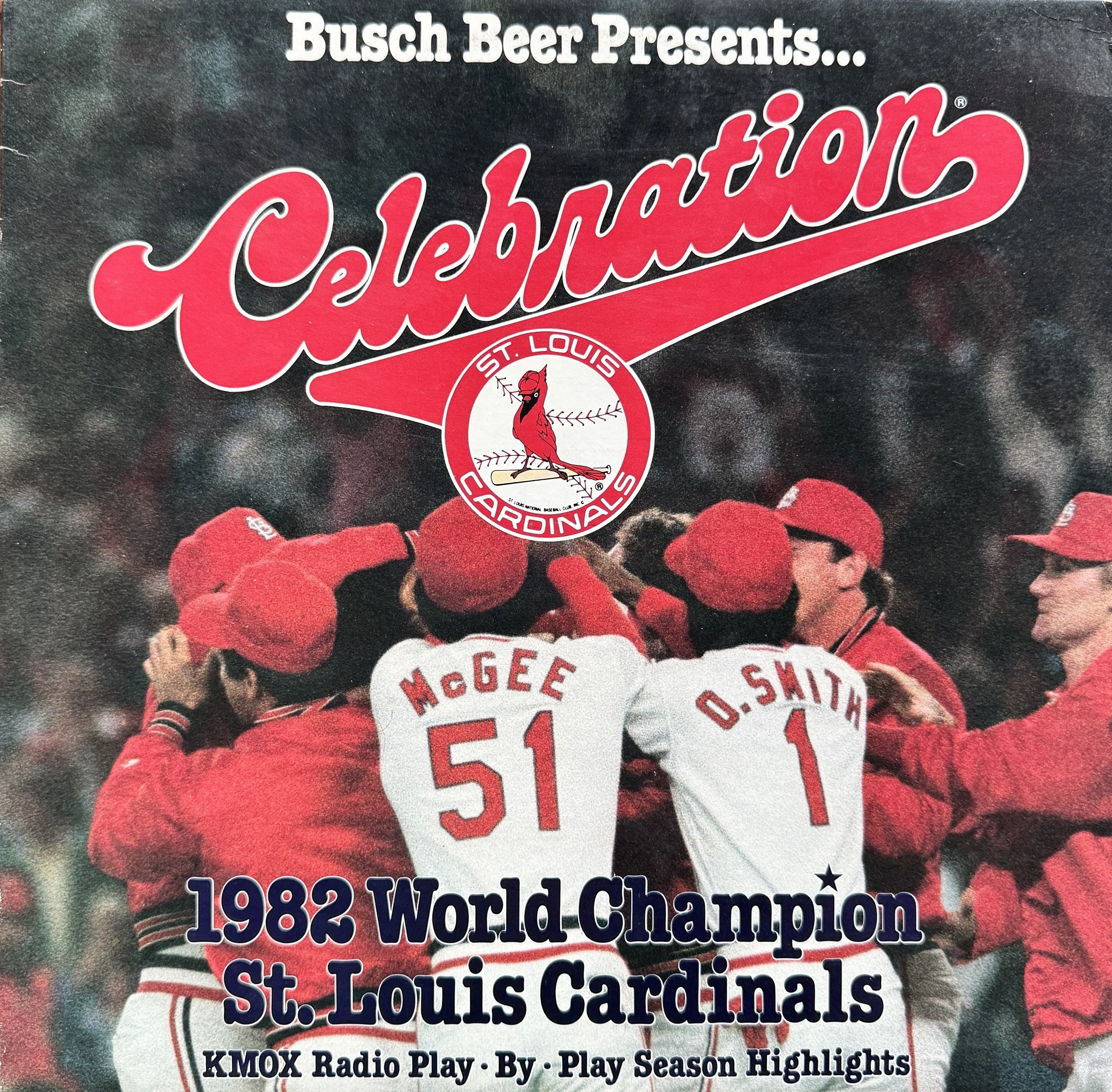
1982 World Champion St. Louis Cardinals
I recall in fantastic detail the time spent with my father on the back porch of my parents’ home on Edgewater Drive in Springfield, Missouri – how the indoor-outdoor carpet felt on the bare soles of my feet, the sound the wind made whispering through the tight weave of the stretched screen, the hard comfort of the deep wicker chairs. We often ate dinner out there. Plenty of times I excused myself to go mow the grass – or be sent under orders to do so. I would finish covered in sweat and grass clippings then sit on the porch with my father and drink a Dr Pepper and Ocean Spray Cran-Ras on the rocks – having poured a glass for Dad, too – and read Sports Illustrated or Still Life With Woodpecker or race my dad to solve the Jumble in that day’s Springfield Leader & Press (afternoon newspapers!). In the best of those evenings it was hot when I started the Lawn-Boy and then a breeze would pick up and the evening would cool before I finished, just ahead of a gentle rain. There was no better place to be in the summer than hidden away behind a drapery of climbing vines, rain falling, light from the porch probing into the now-dark back yard, listening to a baseball game and commentating ourselves along with the play call from Jack Buck and the musings of Mike Shannon.
My parents were out of town in October. Of course, I spent the unsupervised time throwing beer parties at the house. Game 7 was on a Wednesday, perfect time to have the guys over to support Anheuser-Busch. When Bruce Sutter got the final out to seal the Series, Darrel Porter jumped into his arms and Glenn and Nieman and Kevin and Bob and Steve and I started our own mosh pit in my parents’ living room, jumping and pinballing around in jubilation. Beer was spilled. Hoots were hollered.
I can still see the console TV as it tipped and teetered at 10:10 p.m. Central. I was already concocting an elaborate tale of a home invasion to explain away the busted television. Steve and Glenn – tall and long basketball and baseball players with deft reaction times – lunged to make the save, much like Bruce Sutter got the pitching save that concluded with his nine-pitch battle against Gorman Thomas. The Brewers slugger fouled off three in a row on a 3-2 count before striking out swinging, a mighty swipe to end the game and seal the championship for the Cardinals.
It capped a dramatic year. The Cardinals spent 126 days in first place, but it didn’t start auspiciously. St. Louis lost three of its first four games to start the season. The worm turned, as Mike Shannon would always say, on April 11 when the Cardinals beat the Pirates.
“It’s over! It’s over! And so is the losing streak,” Jack Buck emphasized on the radio.
Unknown then, the start of the season’s narrative, was the 12-game winning streak immediately following. That was the longest for the club since 1943. The unknown, that’s the theme of listening to this year and the way baseball must be heard. Each hit, each victory, could very well be the turning point. A streak may be beginning.
Themes and identity develop the same way, over time and only evident in retrospect. St. Louis had a style. Buck and Shannon called it all year long, described it, noted its novelty. Put the ball in play, get on base. Take the extra base. Steal. Take risks. Move the runner. Make the other team nervous, push them into mistakes. Pounce.
A May 8 game against the Braves exemplified the style of play and the team’s identity. Tied at 7 in the ninth, Lonnie Smith walked. The Braves, figuring he would steal, pitched out. Lonnie stole the base anyways. Ozzie Smith bunted to advance the runner, but he wasn’t willing to cede the out, accept the sacrifice. He motored down to first and forced an error, with the ball skittering away. Lonnie scored. The Cardinals won on a run born of speed, aggression, confidence. Speed has its own powers, not only for the benefit of the swift, but also in its ability to get in the heads of opponents. Fielders and pitchers rush and screw up in their haste. They lose focus on the basic building blocks of success when the must deal with speed. At bat, speed chases down liners to the gap, speed means reaching screaming ground balls and nails runners. It can make a hitter think he can’t catch a break.
There was power, too, slugging (if not homers) that took advantage of that speed. June 8 in Montreal, tied 3-3 in the 12th, and Willie McGee smashed a hit to right, scoring Ozzie Smith who had walked ahead of him.
To watch recording of players in the ‘70s and these Cardinals in the ‘80s is to realize how slight they are. St. Louis had a lineup of skinny, slight guys. They looked the part of scrapping speedsters.
“McGee hit the chalk out of the right field corner to take the lead,” Buck called in that game against the Expos. It was a triple for Willie and he stood on third. Ken Oberkfell put down a squeeze bunt and Willie scored.
The Cardinals won 5-4 in 12 innings. That was one of an incredible 57 one-run games St. Louis played for a 35-22 record in those single-tally games. Incredible. Every night was a nailbiter. The summer nights on the back porch kept you awake with the movement on the bases and in the field, the razor’s edge victories.
It kept up all season.
In August, on my sister’s birthday – we undoubtedly spoke to her in the morning, the family all getting on the two extensions of the land line for the long-distance call – the Cardinals beat the Giants 7-6 after Lonnie Smith smacked a hit and kept running and running.
“They’re going to try to score him!” Shannon called as Smith was waved in from third. “Here’ the throw as he rounds third. He’s safe! An inside the park home run!”
Again, the next night, the habit continued. Glenn Brummer (even his name sounds slow), a 200-pound catcher from Illinois, stole home to beat the Giants in the 12th inning.
“Brummer’s the big runner. He’s at third. Two down. Sacks jammed. Lavelle tp the belt. Brummer’s stealing home. Saaaaaffffee!,” Shannon said.
The Cardinals met the Braves for the National League pennant. Atlanta won the NL West with an 89-73 record, sliding in a game ahead of the Dodgers and two better than the Giants in the final standings.
An inital go at the first game of the National League Championship Series was washed out by rain before the game became official. Imagine the social media outrage if a game was called mere outs away from being official with Atlanta ahead 1-0. But the game was canceled and they started over the next night. The Cards swept the series in three games.
It was on to the World Series against the Brewers, a team that came into existence in that carnation in 1970 when the year-old Seattle Pilots moved to Wisconsin. They were in the American League then, too. Milwaukee went the full five games against the California Angels after winning the AL East by a game over the Orioles. Harvey Kuenn took over after Buck Rodgers was fired at the beginning of June. The Brewers were known as Harvey’s Wallbangers for their slugging ways.
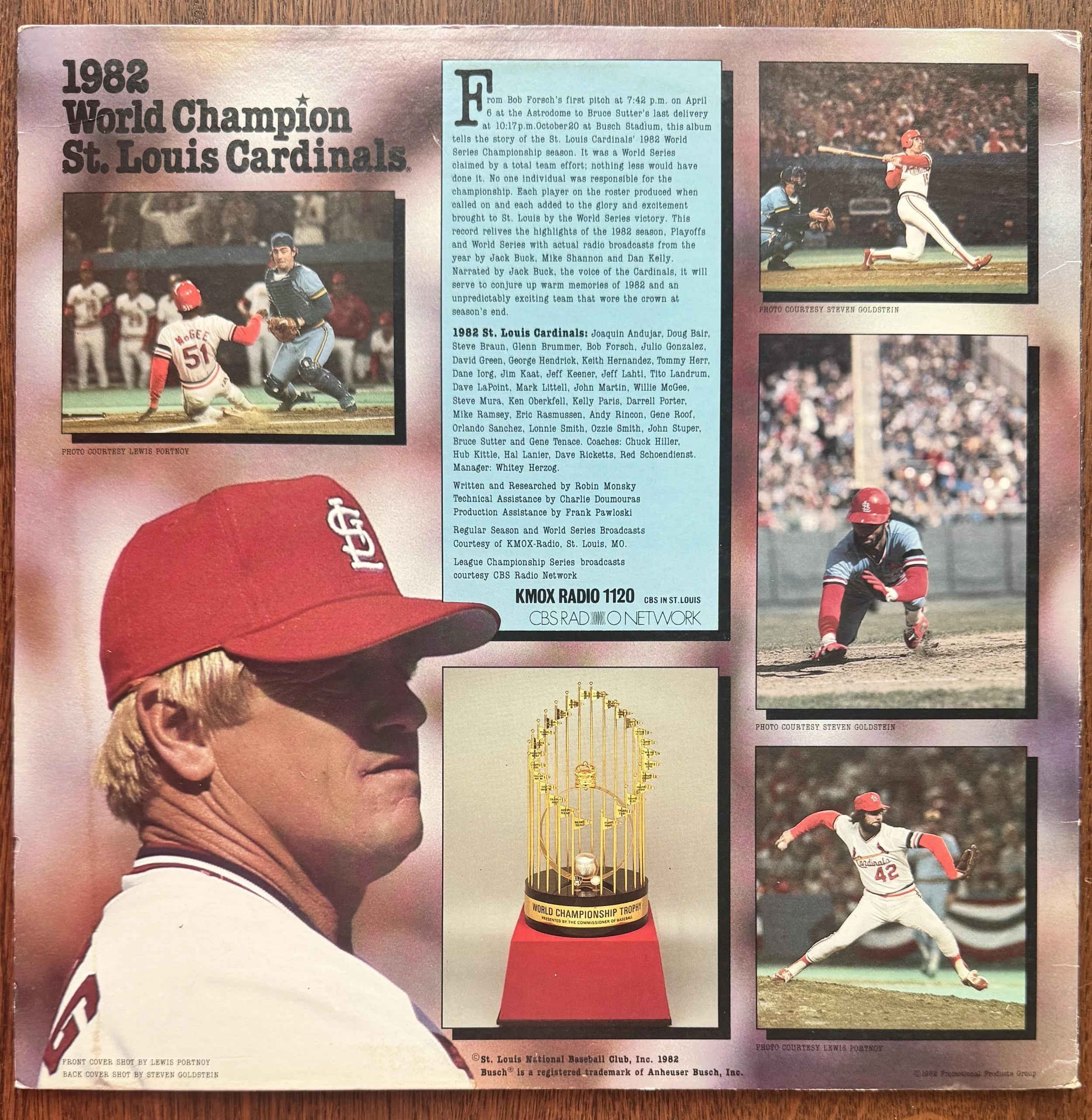
1982 World Champion St. Louis Cardinals Back
This commemorative album differs from the ‘60s versions because they include the postseason rights. KMOX broadcast those games on the radio and produced the recording – it was Anheuser-Busch, owner and sponsor of the Cardinals, who produced the LPs in ‘64 and ‘67. The recording is twice the length of the predecesssors, jamming the grooves to the edges on both sides.
So we get World Series calls as well.
Game 1 was a blowout, with the Brewers prevailing 10-0 in St. Louis.
The Cardinals returned to regular season form with a 5-4 victory in Game 2. Then St. Louis took homefield advantage back with a 6-2 win in the next game in Milwaukee. They were on the ropes when they returned home, facing elimination with the Brewers ahead 3-2 games. In a disjointed Game 6 stopped twice for rain and delayed more than 2½ hours, the Cardinals knotted the Series at three games apiece with a sloppy 13-1 victory to set up a decisive Game 7 on October 20.
Former Cardinal Pete Vukovich started for the Brewers and Joaquin Andujar, One Tough Dominican, pitched seven innings of 3-run ball and left the game with the Cardinals ahead 4-3. Bruce Sutter, the former Cub, came in for the six-out save. St. Louis added the pair of insurance runs in the eighth for a bigger cushion. The big-swing Brewers were always a threat.
Sutter put down slugging former Cardinal Ted Simmons, Ben Oglivie, and Gorman Thomas – the biggest bats in the Milwaukee lineup – in order. The Cardinals were once again world champions.
It was a thrilling call from Jack Buck who raised his enthusiasm with each batter, with each pitch. Sutter threw 10 pitches to Thomas. The Brewers cleanup hitter fouled off three pitches on a full count before a big whiff.
“Swing and a miss and that’s a winner. That’s a winner. A World Series winner for the St. Louis Cardinals,” Buck told his audience, rising to the occasion.
The story of the team and the year was complete. There were years of Whitey Ball ahead, with this identity firmly established. None of that was clear to begin the year, but it became more apparent with each broadcast, with each chapter of pitches and hits and games making the story more cohesive.